Backcourt Fatigue Clusters Reshape Fourth-Quarter Totals Markets in Extended NBA Playoff Runs
Extended NBA playoff series have started revealing distinct patterns where clusters of backcourt minutes create measurable shifts in fourth-quarter scoring outputs, and these changes directly influence totals markets as series stretch beyond five games. Observers tracking 2026 postseason data note that guards logging heavy workloads across consecutive high-minute outings often see their efficiency drop in the final twelve minutes, which alters both team pace and defensive rotations in ways that reshape over-under calculations.
Understanding Backcourt Workload Accumulation
Playoff schedules pack games into tight windows while series extend to six or seven contests, and backcourt players absorb the largest cumulative minute loads because coaches rely on them for primary ball-handling duties. Research from league tracking systems shows that point guards and shooting guards average 42-plus minutes per game once a series reaches game five, whereas frontcourt counterparts receive more staggered rest through substitution patterns. This concentrated fatigue manifests in slower decision-making, reduced lateral quickness, and fewer transition opportunities, all of which compress scoring windows in the closing period.
Data from the first two rounds of the 2026 playoffs indicates that teams advancing through longer series experience an average 3.8-point decline in fourth-quarter points per game compared with shorter series outcomes. The dip occurs even when overall game totals remain stable, because early-quarter production masks the late-game slowdown until betting markets adjust their fourth-quarter-specific lines.
Impact on Fourth-Quarter Totals Markets
Betting exchanges began separating fourth-quarter totals into distinct offerings during the 2025 postseason, and volume on these micro-markets increased sharply once extended series became common in June 2026. When backcourt clusters reach fatigue thresholds, fourth-quarter totals trend toward the under at a higher clip because possessions lengthen and three-point attempts decline. Sportsbooks responded by shading fourth-quarter totals lower in series projected to last six games or more, particularly when both teams feature high-usage guards on the injury report.
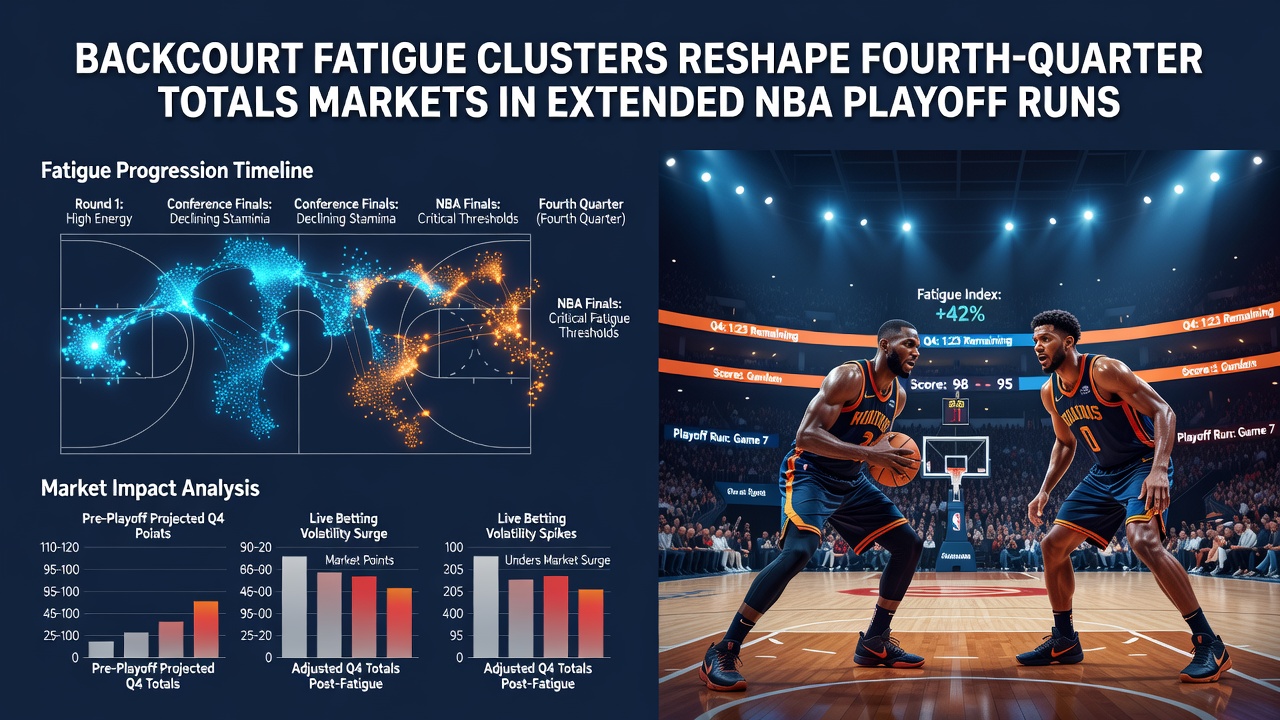
One analytics group studying play-by-play logs found that fourth-quarter overs hit at only 41 percent in games seven of conference semifinal series during the current postseason cycle. The same dataset shows defensive schemes tightening around perimeter players who have already logged heavy mileage, which reduces open looks and forces contested mid-range attempts that lower overall output. Market makers therefore moved fourth-quarter totals down by an average of 2.5 points once series length indicators crossed the five-game threshold.
Case Patterns Across Recent Series
Several conference semifinal matchups in May and early June 2026 demonstrated the effect clearly. In one seven-game set featuring two backcourt-heavy offenses, fourth-quarter scoring fell below the series average in five of the seven contests once both teams reached minute thresholds above 38 per guard. Sharp bettors who tracked cumulative backcourt minutes identified the under opportunity in games six and seven before lines fully adjusted, producing consistent value on the lowered totals.
Another series between teams relying on veteran guards showed similar compression, yet frontcourt substitutions mitigated some of the scoring drop because fresh bigs maintained interior efficiency. The contrast highlights how roster construction influences whether fatigue clusters fully translate into market movement, and oddsmakers now incorporate backcourt minute trackers into their pre-series modeling.
Market Adjustments and Bettor Response
Bookmakers updated their algorithms to weight backcourt usage rates more heavily when setting fourth-quarter totals for potential game-six and game-seven scenarios. Industry reports indicate that limits on fourth-quarter props tightened during June 2026 as action concentrated on these adjusted lines. Bettors monitoring player-tracking data gained an edge by cross-referencing fatigue indicators with historical fourth-quarter output splits, allowing them to anticipate line movements before public money pushed totals further.
League sources confirm that play-by-play granularity improved in 2026, giving analysts cleaner separation between backcourt and frontcourt minute clusters. This refinement helped quantify exactly when fatigue effects become statistically significant, typically after the 155 cumulative minute mark for primary guards in a single series.
Conclusion
Backcourt fatigue clusters have become a measurable variable that reshapes fourth-quarter totals markets once NBA playoff series extend, and data from the 2026 postseason confirms the pattern holds across multiple conference matchups. Teams and bettors who integrate minute tracking with scoring splits now operate with clearer projections for late-game outputs, while sportsbooks continue refining limits to account for the workload-driven shifts observed in extended runs.