Clay to Grass Transitions Reshape Point Spread Dynamics Across Tennis Tours
Casey Krüger · Jul 22, 2026
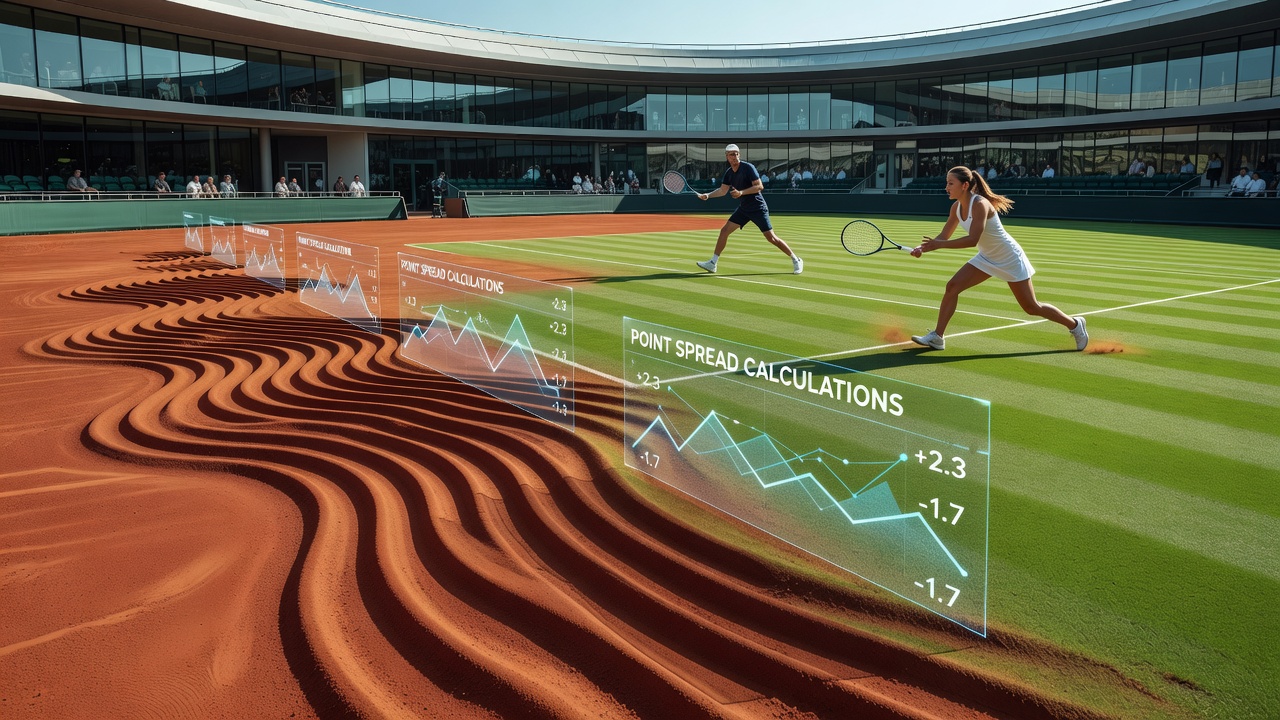
Clay to Grass Transitions Reshape Point Spread Dynamics Across Tennis Tours
Clay courts slow the ball and produce higher bounces while grass surfaces accelerate play with lower trajectories, and these differences force adjustments in player performance metrics that directly influence how bookmakers set point spreads for professional matches. Observers note that the annual shift from Roland Garros to Wimbledon creates measurable changes in expected game totals and set margins, prompting analysts to recalibrate models each June and July. Data from ATP and WTA events shows average rally lengths drop by 25 to 30 percent when players move onto grass, which alters win probabilities for baseline specialists versus serve-and-volley competitors.
Surface Characteristics and Performance Metrics
Clay demands endurance and topspin consistency whereas grass rewards first-strike aggression and quick court coverage, so statistical services track first-serve win percentages and break-point conversion rates more closely during the transition weeks. Researchers at sports analytics firms have compiled multi-year datasets indicating that players with strong clay records often see their implied probabilities fall by 8 to 12 points on grass, and these shifts feed directly into spread calculations. Bookmakers adjust over-under lines for total games per match because grass contests finish faster on average, with best-of-three sets typically concluding in 20 to 25 minutes less than comparable clay encounters.
July 2026 schedules place several ATP 500 and WTA 1000 events immediately after the grass majors, creating a compressed window where surface adaptation data becomes especially valuable for oddsmakers. Figures from the International Tennis Federation reveal that aces per match increase by roughly 35 percent on grass compared with clay, which pushes spread models to weight serving statistics more heavily in early-round calculations. Those who model tennis outcomes adjust variance assumptions because grass produces more one-sided sets when a dominant server faces a return-oriented opponent.
Betting Market Adjustments and Spread Calculations
Point spread calculations incorporate surface-specific historical performance because raw Elo ratings or ranking points alone fail to capture the rapid style shift required between tournaments. Analysts incorporate variables such as previous surface win rates, fatigue from travel between events, and head-to-head results on each surface to generate adjusted probabilities. When these inputs change, spreads for individual games and sets move accordingly, with sportsbooks releasing updated lines within 48 hours of the French Open final.
One study of 2024 and 2025 transition periods found that underdogs with clay-heavy schedules covered spreads at a 52 percent rate in the first week on grass, whereas favorites posted a 48 percent cover rate, illustrating how models initially overcorrect before settling. Data providers update their algorithms daily during this window, feeding new match samples into machine-learning frameworks that recalibrate expected margins. Those frameworks draw from thousands of tracked points to isolate surface effects from other factors such as weather or court speed ratings published by tournament organizers.

Player Adaptation Patterns and Statistical Evidence
Players who excel on both surfaces maintain stable spread values across the transition, yet the majority experience a temporary dip that oddsmakers quantify through rolling performance windows. Coaches and support teams compile video breakdowns and movement data to accelerate adaptation, and these preparations appear in aggregate statistics as reduced unforced errors after the second grass event of the season. Research indicates that left-handed players sometimes gain a small additional edge on grass due to serve angles that exploit the faster surface, prompting minor spread tweaks in specific matchups.
Market makers at major betting operators monitor early grass-week results to refine spreads for later tournaments, and this feedback loop produces tighter lines by the second or third week of the grass swing. Historical records show that matches between two clay specialists produce higher totals on grass than anticipated because both players struggle to hold serve initially, whereas contests featuring at least one grass specialist trend toward lower totals once adaptation occurs. Observers track these patterns through public databases maintained by the ATP and WTA, which publish surface-specific win percentages updated after every event.
Regional Tournament Impacts and Scheduling Effects
European swing events held on grass shortly after the majors attract different player fields than clay events, and the resulting changes in depth and motivation further influence spread accuracy. North American and Asian hard-court events that follow the grass season inherit residual effects because some players carry grass-court rust into the next surface, although the impact diminishes within two weeks. Regulatory bodies in Australia and Canada have published reports on sports integrity that include surface-transition data as one variable in match-monitoring algorithms, helping identify unusual betting patterns that may stem from adaptation miscalculations rather than other factors.
Industry reports from organizations such as the European Gaming and Betting Association document how operators refine risk models around these transitions, incorporating real-time court-speed measurements released by tournament directors. These measurements allow spread calculations to account for year-to-year variations in grass conditions caused by weather or maintenance practices, which can shift average match durations by several minutes.
Conclusion
Clay-to-grass transitions continue to require ongoing refinement of point-spread models because surface-driven changes in rally length, serve dominance, and player adaptation produce measurable effects on match outcomes. Data collected across multiple seasons demonstrates that updated inputs for surface history and recent form improve the accuracy of lines released during the June and July window. As professional circuits maintain packed schedules that move rapidly between surfaces, analysts and operators rely on expanding datasets and refined algorithms to keep spread calculations aligned with observed performance patterns.