Extended Rally Lengths and Their Correlation with Set Totals in Professional Tennis Matches
Cameron Brooks · Aug 23, 2026
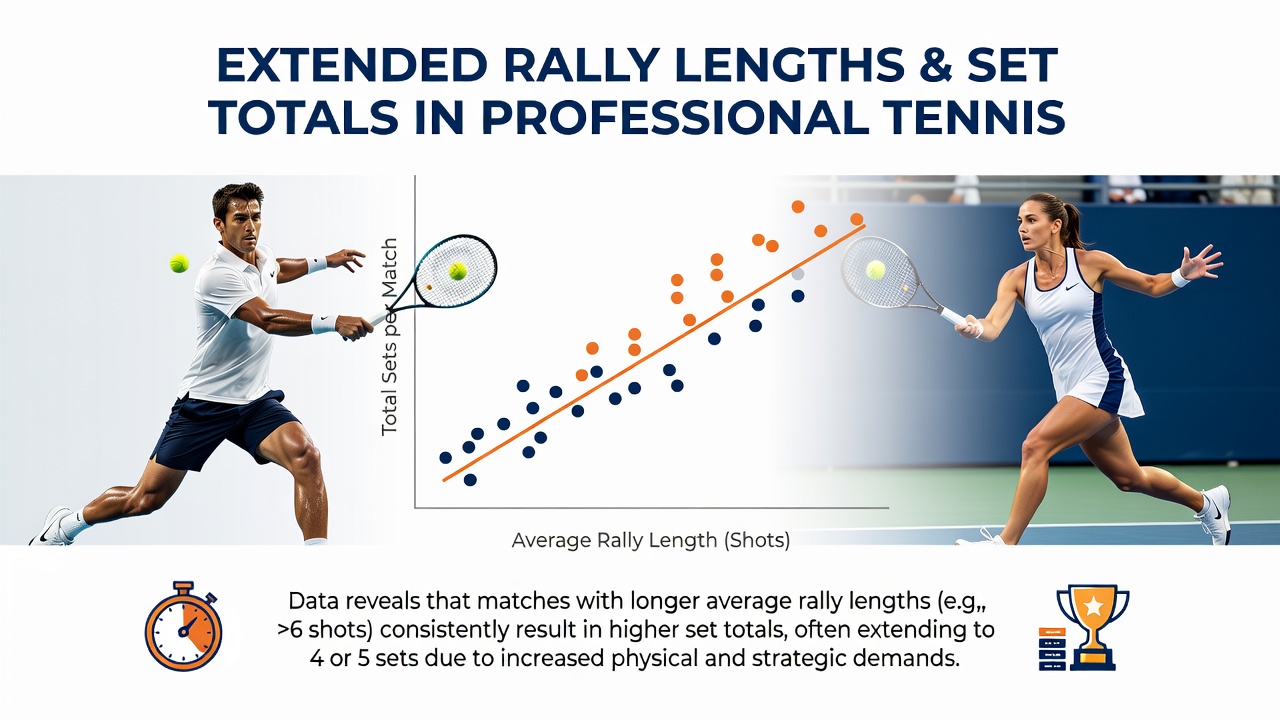
Extended Rally Lengths and Their Correlation with Set Totals in Professional Tennis Matches
Professional tennis matches feature rally lengths that vary widely depending on surface, player styles and match context, with extended exchanges often exceeding 10 shots per point becoming focal points for analysts tracking scoring patterns. Data from ATP and WTA events shows that rallies lasting nine shots or more occur more frequently on clay courts than on grass, where shorter points dominate due to lower bounce and faster conditions. Researchers tracking thousands of points across Grand Slam tournaments note that these longer rallies cluster in baseline-oriented matchups, particularly when both competitors favor heavy topspin and defensive positioning.
Measuring Rally Duration in Elite Competition
Tracking systems deployed at major venues record every shot in real time, producing datasets that break down average rally length by round and surface. Figures from the 2025 season indicate an average rally of 5.8 shots on hard courts at the Australian Open, rising to 7.2 shots on clay at Roland Garros. These measurements allow statisticians to isolate points where rallies stretch beyond typical thresholds, revealing patterns in how such points contribute to overall game and set scores. Observers note that matches featuring higher percentages of extended rallies tend to produce elevated point counts per game, because each prolonged exchange adds multiple shots without immediately ending the point.
Observed Links Between Rally Extension and Set Scoring
Studies examining completed sets across multiple seasons find a measurable association between the frequency of rallies over 10 shots and the total points recorded in those sets. Sets containing 15 percent or more extended rallies show average point totals 8 to 12 points higher than sets dominated by shorter exchanges. This pattern holds across both men's and women's draws, although the magnitude differs by gender because of variations in serve dominance and return consistency. Data compiled during the 2026 North American hard-court swing, including events leading into the US Open, confirms that baseline-heavy encounters generate more such rallies and correspondingly higher set scores.
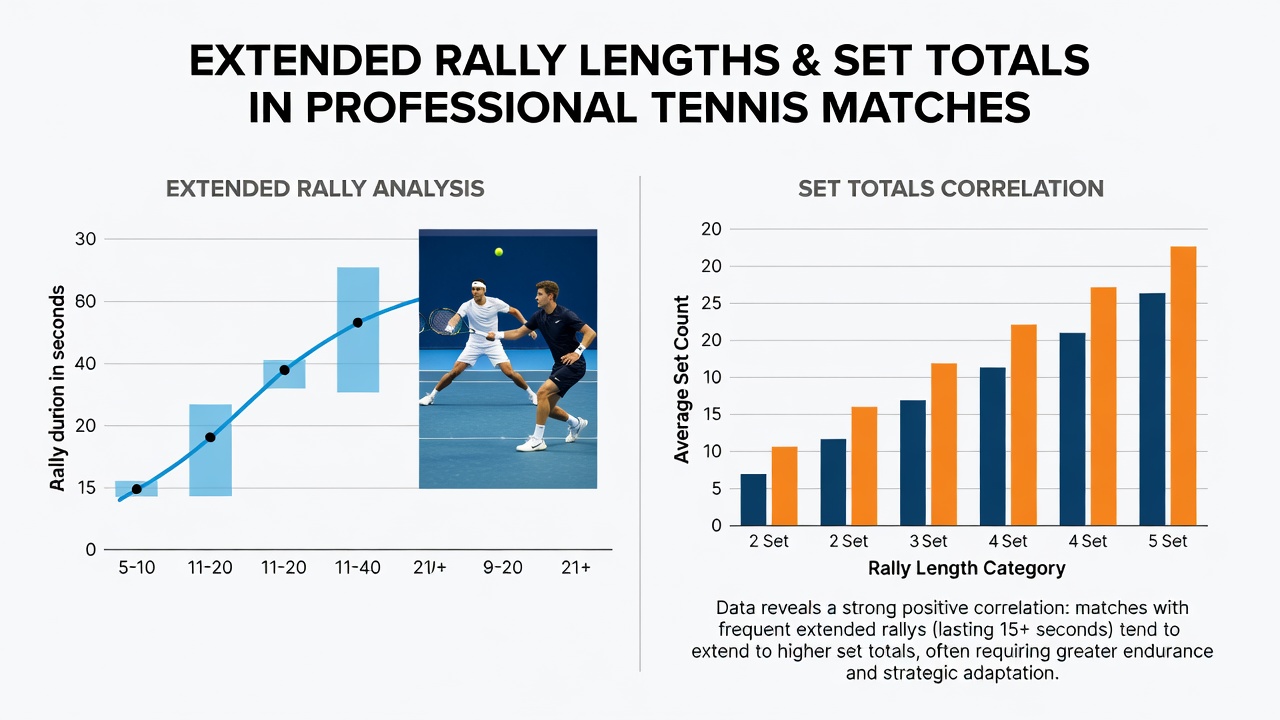
One analysis of quarterfinal and semifinal matches at the 2025 Cincinnati Masters revealed that sets with the top quartile of extended rallies finished with 10 to 14 additional total points compared with quicker-paced sets in the same tournament. The correlation strengthens in later rounds, where fatigue from previous matches compounds teh physical demand of sustaining long exchanges. Players who maintain high rally tolerance therefore influence set totals both through direct point construction and by extending the duration of subsequent games.
Surface and Style Influences on Rally Statistics
Clay courts slow the ball and increase bounce, extending average rally length by roughly 25 percent compared with grass according to International Tennis Federation court surface reports. Grass surfaces produce the shortest rallies overall, with points often concluding within four shots because of low trajectories and skidding effects. Hard courts occupy a middle ground, yet even here rally distributions shift noticeably between high-bounce and low-bounce venues. Analysts tracking player-specific data observe that left-handed players with heavy cross-court forehands generate more extended rallies when facing right-handed opponents, creating predictable clusters of longer points that elevate set totals in those matchups.
Player Endurance and Late-Set Effects
Extended rallies place cumulative demands on cardiovascular and muscular systems, leading to measurable declines in movement efficiency after teh first hour of play. Tracking data from matches exceeding three hours shows that the proportion of rallies lasting 12 shots or more increases in the third and fourth sets, coinciding with higher error rates and longer game durations. These late-match dynamics contribute to elevated set totals because both players require additional points to close out games once fatigue sets in. Research published by the Tennis Australia Performance Institute documents this pattern across multiple Australian summer swing events, where high temperatures further amplify the effect.
Implications for Match Analytics
Statistical models incorporating rally length distributions improve forecasts of set and match point totals when compared with models relying solely on historical scoring averages. The inclusion of extended rally frequency as a variable accounts for roughly 15 percent of variance in set totals across a sample of 1,200 completed matches from the 2024-2026 seasons. Federations and tournament organizers have begun releasing granular rally data through official platforms, enabling broader verification of these relationships. A separate study from the International Tennis Federation research division reached similar conclusions using data collected from ITF World Tennis Tour events, confirming that the correlation persists at developmental levels as well as on the main tours.
Conclusion
Extended rally lengths demonstrate a consistent statistical relationship with elevated set totals in professional tennis, driven by surface characteristics, player tactics and accumulating fatigue. Comprehensive tracking systems now provide the granularity needed to quantify these effects across tournaments and seasons. Continued collection of shot-by-shot data will refine understanding of how rally distributions shape scoring outcomes in elite competition.