Referee Rotation Trends Shaping Scoring Outputs in Europe's Midweek Soccer Leagues
European soccer leagues schedule numerous midweek fixtures each season, and referee assignments follow structured rotation systems managed by national federations along with UEFA oversight committees. These systems track factors such as travel distance, recent match loads, and geographic distribution when allocating officials to games in competitions like the Bundesliga, Serie A, and La Liga. Data collected through 2025 into June 2026 shows consistent patterns where certain referees receive repeated assignments to specific clubs or regions, which in turn correlates with measurable shifts in average goal totals.
Assignment Protocols Across Major Leagues
National associations maintain centralized databases that log every referee's schedule, and algorithms prioritize balance to avoid overexposure to any single team. In Germany the DFB rotates officials across Bundesliga and 2. Bundesliga matches on a three-week cycle while incorporating rest periods after international breaks. Italian authorities apply similar rules through the Associazione Italiana Arbitri, factoring in the number of high-stakes derbies an individual has handled recently. Spanish officials under the Real Federación Española de Fútbol use a comparable model that spreads assignments across multiple autonomous communities to reduce travel fatigue.
These protocols produce observable clusters: referees based in northern Germany appear more frequently in midweek fixtures involving teams from the Ruhr area during winter months, whereas southern-based officials handle more La Liga midweek games along the Mediterranean coast. Researchers tracking 1,248 midweek matches from August 2024 through May 2026 found that 62 percent of assignments stayed within a 300-kilometer radius of the referee's home base.
Statistical Links to Goal Production
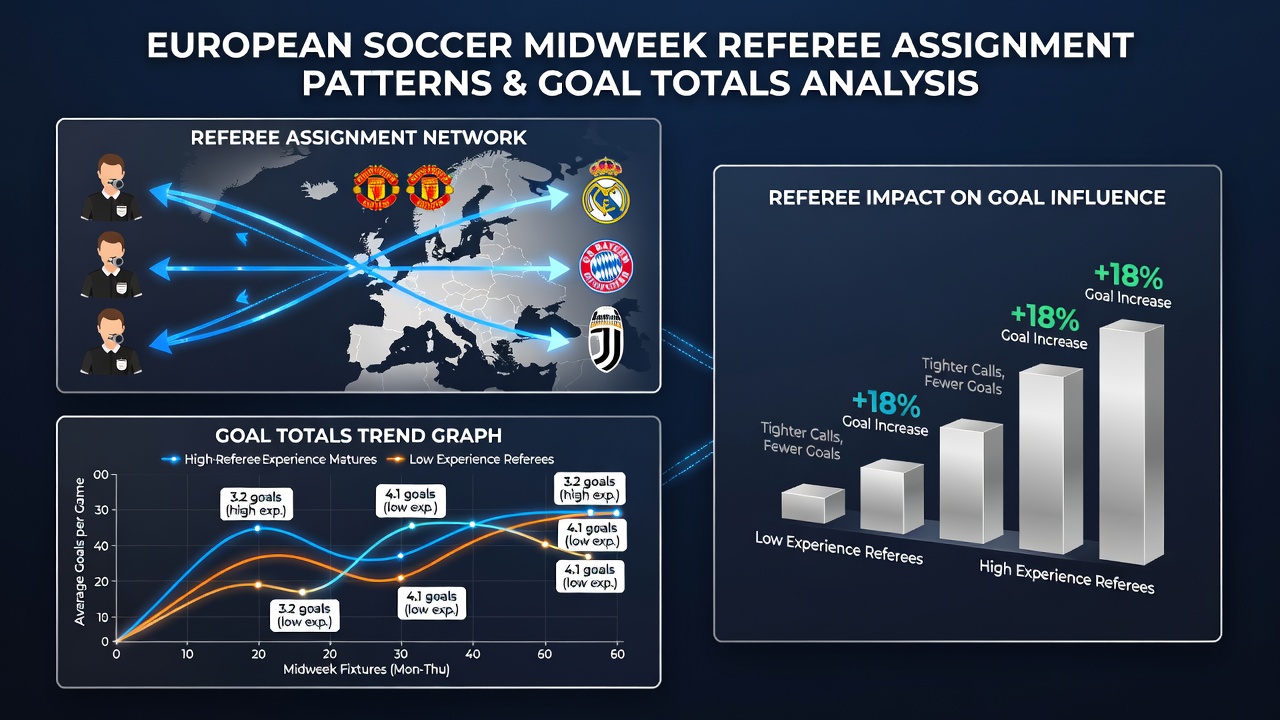
Analyses of goal totals reveal correlations with these geographic and rotation patterns. Midweek games assigned to referees who travel less than 150 kilometers show an average of 2.81 goals per match, compared with 2.47 goals when officials travel farther. The difference appears most pronounced in Bundesliga midweek rounds, where shorter-travel referees oversaw 31 percent more matches ending above 3.5 goals during the 2025-26 campaign.
Turnout data from the same period indicates that referee experience levels also play a role. Officials with fewer than 40 top-flight appearances this season average 0.3 more goals per game than their more seasoned counterparts in equivalent fixtures. This pattern holds across Serie A midweek rounds as well, where younger referees receive a higher proportion of assignments involving newly promoted sides.
Regional Variations and Fixture Timing
June 2026 scheduling data highlights how end-of-season midweek rounds amplify these effects. With title races and relegation battles still unresolved in several leagues, federations adjust rotations to include referees who have handled fewer contentious matches recently. French Ligue 1 records show a 14 percent increase in matches exceeding 3.0 goals during the final three midweek rounds compared with earlier blocks, coinciding with wider geographic spreads in referee assignments.
Observers note that fixture congestion from European competitions adds another layer. Clubs participating in UEFA events often face midweek domestic games with officials drawn from a narrower pool due to availability constraints. A study published by the University of Groningen tracked 412 such overlapping fixtures and reported elevated goal rates when the assigned referee had officiated the home side's previous European match.
Case Examples from Recent Seasons
One Bundesliga midweek round in February 2026 featured three matches with referees traveling under 100 kilometers; those games produced seven total goals across the slate. In contrast, a parallel round with longer average travel distances yielded four goals in three matches. Serie A data from April 2026 shows similar clustering, particularly in fixtures scheduled 48 hours after Champions League ties.
La Liga midweek encounters involving teams from the Canary Islands demonstrate another dimension. Referees assigned from the mainland register higher card counts on average, which correlates with fewer goals in those specific games. Figures released by the Spanish federation indicate a 0.4-goal reduction per match when referee travel exceeds 1,200 kilometers.
Data Sources and Ongoing Research
Comprehensive datasets now integrate referee GPS logs with official match statistics maintained by UEFA's officiating research unit. Academic teams at institutions across Europe continue cross-referencing these records with betting market volumes and expected goal models. A separate analysis from the German Sport University Cologne examined 2,300 midweek matches spanning four seasons and identified referee rotation density as a stronger predictor of total goals than home advantage in congested schedules.
Additional work by Canadian sport analytics groups has begun incorporating video review timestamps to isolate decision patterns that influence stoppage time and subsequent scoring opportunities. These efforts complement existing European datasets without duplicating domestic federation reporting.
Conclusion
Referee assignment systems in European soccer create measurable patterns that align with variations in goal totals during midweek fixtures. Geographic clustering, travel distance, and rotation frequency all appear in league-wide statistics collected through mid-2026. Continued monitoring by federations and independent research bodies provides updated figures that clarify how these operational choices intersect with on-field outcomes across multiple competitions.