Stadium Wind Currents Reshape Passing Accuracy Across Professional Gridiron Venues
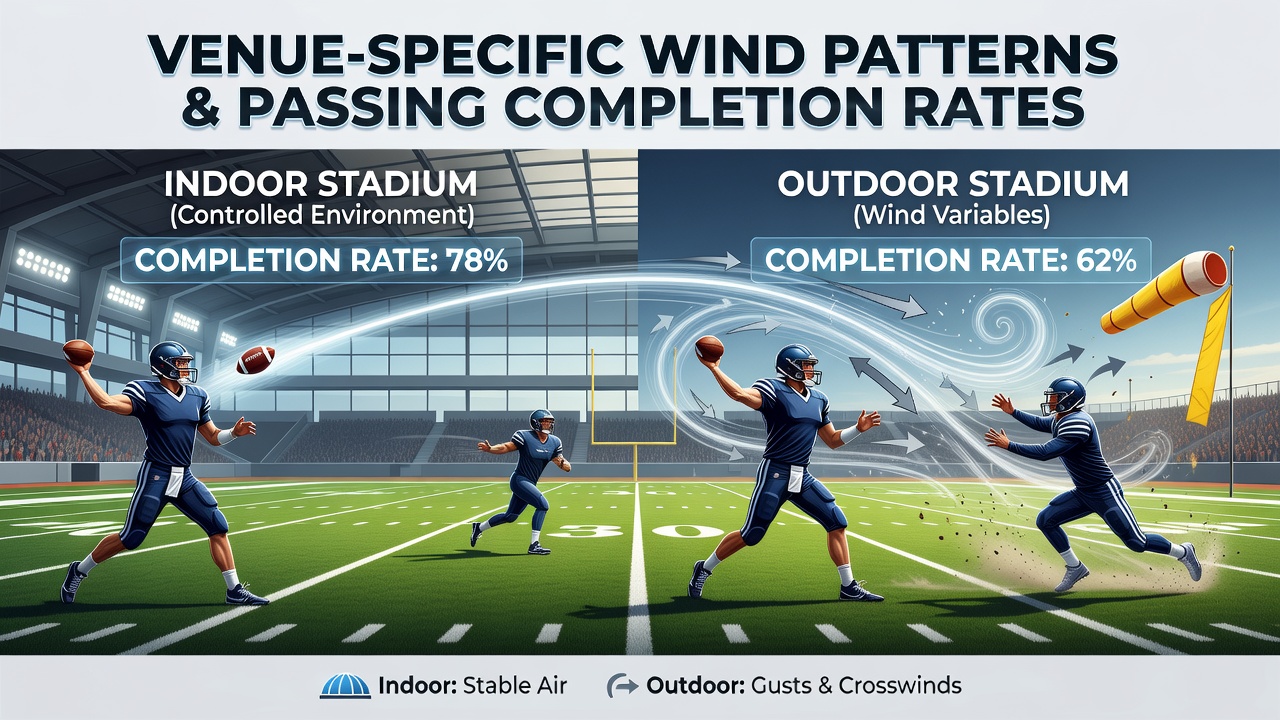
Professional gridiron passing plays face consistent interference from venue-specific wind patterns that vary sharply by stadium design, geographic location, and seasonal conditions, with completion rates dropping measurably in exposed outdoor venues while remaining stable in domed facilities.
Venue Architecture and Local Wind Behavior
Stadiums positioned near large bodies of water or in open plains experience stronger crosswinds and gusts that directly affect ball trajectory during throws longer than 20 yards, whereas enclosed or partially shielded structures block these forces and produce more predictable outcomes. Researchers at institutions including the University of Michigan have documented how architectural elements such as open end zones, upper decks, and surrounding terrain funnel air currents into specific zones on the field, creating pockets of turbulence that quarterbacks must anticipate during pre-snap reads.
Data collected across multiple seasons shows outdoor venues record completion percentages 4 to 7 points lower on average for passes exceeding 15 yards when sustained winds reach 15 miles per hour or higher, while shorter routes under 10 yards demonstrate smaller variances because the ball spends less time airborne. Observers note that teams playing in these environments adjust route trees and play-calling tendencies to favor timing-based concepts less susceptible to lateral drift.
Regional Climate Influences on Completion Metrics
Coastal and Great Lakes stadiums encounter prevailing winds that shift direction throughout the afternoon and evening, requiring real-time adjustments by offensive and defensive units alike. Meteorological records from the National Oceanic and Atmospheric Administration indicate that venues in the Midwest and Northeast experience gustier conditions during late fall and early winter months, periods when many teams schedule home games. These patterns correlate with documented reductions in deep passing efficiency, prompting coaches to increase emphasis on intermediate and screen concepts during windy periods.
Indoor stadiums such as those in Atlanta, Detroit, and Minneapolis eliminate these variables entirely, producing completion rates that align more closely with league averages regardless of external weather systems. Studies comparing matched samples of identical personnel across indoor and outdoor settings confirm the environmental contribution rather than differences in team quality alone.
Statistical Patterns and Play-Type Variations
Analysis of play-by-play data reveals that wind affects certain route combinations more than others, with fade routes and deep outs showing the largest completion rate declines when tailwinds or headwinds exceed typical thresholds. Teams that maintain high completion percentages in such conditions often rely on quick-release timing throws or heavily utilize running backs and tight ends on shorter patterns that minimize exposure to sustained air resistance.
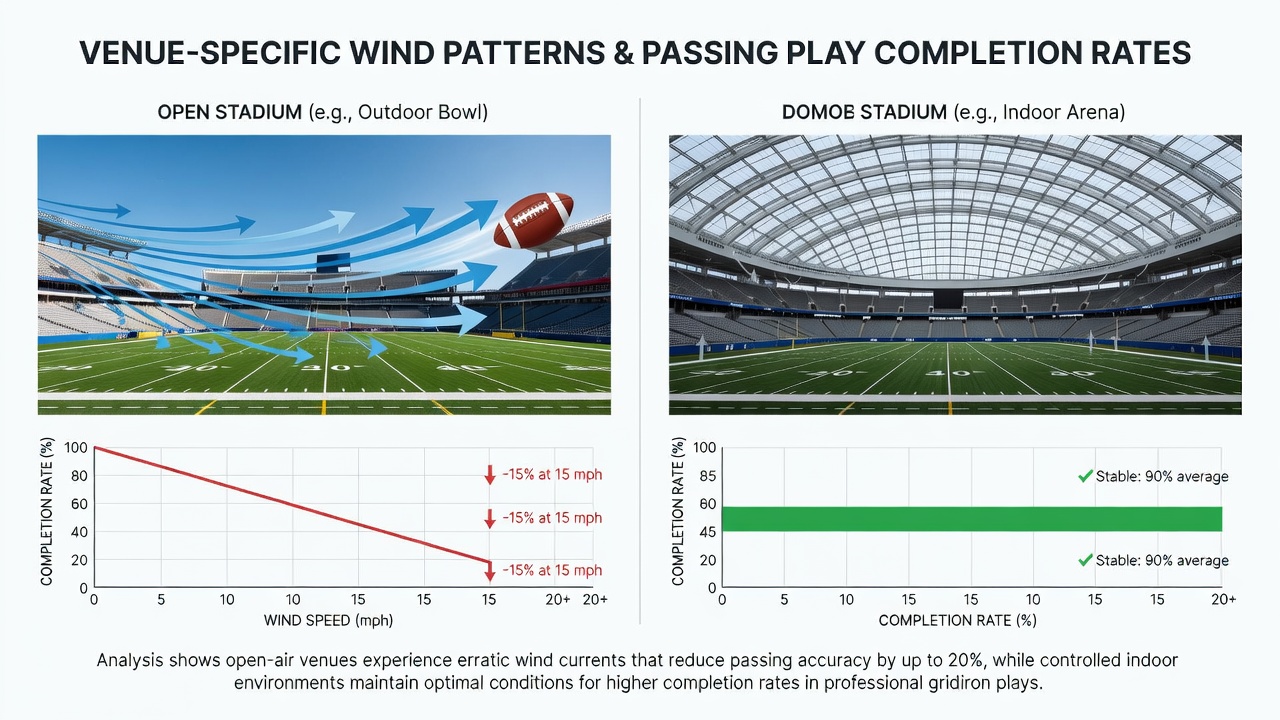
One study tracking performance across 32 venues over five seasons found that certain quarterbacks maintained above-average completion numbers in windy environments through mechanical adjustments including lower release points and increased velocity on intermediate throws. The same research indicated defensive backs benefit from wind assistance on underthrown balls, resulting in elevated interception totals during specific directional wind scenarios.
Measurement Techniques and Predictive Models
Advanced tracking systems now incorporate real-time wind speed and direction sensors at multiple points around the field, allowing analysts to generate venue-specific adjustments for expected completion rates. These models integrate historical data with current atmospheric readings to forecast how individual play types will perform under given conditions at each stadium. Organizations such as the Canadian Meteorological Centre have contributed complementary datasets on regional wind regimes that help refine these projections for cross-border comparative studies.
Teams and broadcast partners increasingly reference these metrics during game preparation and commentary, highlighting how certain venues consistently suppress aerial production while others remain neutral. The patterns hold across both regular season and postseason contests, though sample sizes remain smaller for playoff environments.
Conclusion
Venue-specific wind patterns produce measurable and repeatable effects on professional gridiron passing completion rates, with outdoor stadiums near water or open terrain showing the strongest correlations. Statistical tracking combined with meteorological data has clarified these relationships, enabling more precise performance modeling across different facilities and conditions. As sensor technology and atmospheric analysis continue to advance, the ability to anticipate and account for these environmental factors during game planning will likely expand further.